
GENOTYPIC VARIATION AND YIELD OPTIMIZATION IN BAMBARA GROUNDNUT (Vigna subterranea (L.) Verdc.) UNDER VARYING PLANT POPULATION DENSITIES IN THE SUDAN SAVANNAH
Article Sidebar
Abstract Views | Downloads: 398 / 291
Main Article Content
Abstract
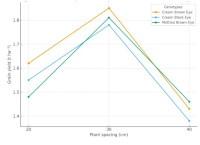
Bambara groundnut (Vigna subterranea L. Verdc.) is an underutilized African legume valued for its resilience to drought and poor soils, yet the genotypic variation in its response to plant population density remains underexplored. This study investigated the growth and yield performance of three bambara groundnut genotypes (Cream Brown Eye, Cream Black Eye, and Mottled Brown Eye) under three population densities (160 × 20 cm, 160 × 30 cm, and 160 × 40 cm) in the Sudan savannah of Nigeria using a split-plot design. Significant effects of genotype, density, and their interaction were observed for plant height, petiole length, and yield components. Wider spacing enhanced vegetative growth, while intermediate density (8 plants m⁻²) maximized grain yield (1.85 t ha⁻¹), reflecting a parabolic density–yield relationship. Among genotypes, Mottled Brown Eye exhibited superior shelling efficiency (82.4%) and productivity index, indicating greater assimilate partitioning and competitive balance under moderate population pressure. The differential density responses among genotypes highlight the presence of exploitable genetic variation for density tolerance and yield stability. These findings suggest that moderate plant density optimizes canopy development, photosynthetic efficiency, and yield per unit area under semi-arid conditions, providing a framework for genotype-specific planting density recommendations to enhance bmbara groundnut productivity and sustainability in dryland cropping systems.
Downloads
Article Details
Section

This work is licensed under a Creative Commons Attribution-NonCommercial-ShareAlike 4.0 International License.
How to Cite
References
Anderson, J. M., & Ingram, J. S. I. (1993). Tropical soil biology and fertility: A handbook of methods (2nd ed.). CAB International.
Ajeigbe, A., Yallou, C. G., Alidu, H., Talabi, A. O., Akaogu, I. C., Annor, B., & Adoti, A. (2024). Matching cereal and legume crop varieties to production systems in the drylands of West and Central Africa. CGIAR. https://cgspace.cgiar.org/bitstreams/5df122e7-2b05-4a8c-aeded6b3316d9fd7/download
Ajilogba, C. F., Olanrewaju, O. S., & Babalola, O. O. (2022). Improving Bambara Groundnut Production: Insight Into the Role of Omics and Beneficial Bacteria. Frontiers in Plant Science, 13, 836133. https://doi.org/10.3389/fpls.2022.836133
Alhassan, G. A., Kalu, B. A., & Egbe, O. M. (2012). The influence of planting densities on the performance of intercropped bambara groundnut with cowpea in Makurdi, Benue State, Nigeria. International Journal of Development and Sustainability, 1(3), 860–879.
Azam-Ali, S. N., Sesay, A., Karikari, S. K., Massawe, F. J., Aguilar-Manjarrez, J., Bannayan, M., & Hampson, K. J. (2001). Assessing the potential of an underutilized crop – A case study using Bambara Groundnut. Experimental Agriculture, 37(4), 433–472. doi:10.1017/S0014479701000412
Bamshaiye, O. M., Adegbola, J. A., & Bamishaiye, E. I. (2011). Bambara groundnut: An under-utilized nut in Africa. Advances in Agricultural Biotechnology, 1, 60–72.
Chimonyo, V. G. P., Wimalasiri, E. M., Kunz, R., Modi, A. T., & Mabhaudhi, T. (2020). Optimizing traditional cropping systems under climate change: A case of maize landraces and Bambara Groundnut. Frontiers in Sustainable Food Systems, 4, 562568. https://doi.org/10.3389/fsufs.2020.562568
Essel, E., Santo, K. G., Berchie, J. N., Khalid, A. A., Abdulai, M., Atakora, K., Ntiamoah, D. A., Norshie, P. M., & Novor, S. (2024). Yield response of Bambara Groundnut [Vigna subterranea (L.) Verdc.] to fertilizer application and plant spacing. Indian Journal of Agricultural Research, 58(5), 811–815. https://doi.org/10.18805/IJARe.AF807
Gerrano, A. S., Eifediyi, E. K., Labuschagne, M., Ogedegbe, F. O., & Hassen, A. I. (2021). Production practices of Bambara Groundnut. In S. A. Oyeyinka & B. I. O. Ade-Omowaye (Eds.), Food and Potential Industrial Applications of Bambara Groundnut (pp. 7–25). Springer, Cham. https://doi.org/10.1007/978-3-030-73920-1_2
Godoy, R., Cahn, M., Toth, J. D., & Kumar, S. (2020). Effects of supplemental nitrogen on sorghum (Sorghum bicolor L.) silage yield, nutritive value, nitrogen utilisation, and soil nitrogen fractions under climate change scenarios. Agriculture, Ecosystems & Environment, 295, 106583. https://doi.org/10.1016/j.agee.2019.106583
Iddrisu, A., Adjei, E., Asomaning, S. K., Santo, K. G., Isaac, A. P., & Danson-Anokye, A. (2024). Effect of variety and plant spacing on growth and yield of groundnuts (Arachis hypogaea L.). Agricultural Sciences, 15(1), 54–70. https://doi.org/10.4236/as.2024.151004
Kamara, A. Y., Omoigui, L. O., Kamai, N., Ewansiha, S. U., & Ajeigbe, H. A. (2018). Improving cultivation of cowpea in West Africa. In S. Sivasankar, D. Bergvinson, P. Gaur, S. Kumar, S. Beebe, & M. Tamò (Eds.), Achieving sustainable cultivation of grain legumes, Volume 2: Improving cultivation of particular grain legumes (Burleigh Dodds Series in Agricultural Science). Burleigh Dodds Science Publishing. https://oar.icrisat.org/10804/1/Improving-cultivation-of-cowpea-in-West-Africa.pdf
Ruzive, A., Govender, L., Mandizvo, T., Shayanowako, A. I., Musimwa, T., Chai, H. H., Massawe, F., Mayes, S., Sibiya, J., & Mabhaudhi, T. (2025). Agro-morphological diversity and breeding potential of Bambara groundnut (Vigna subterranea L. Verdc): Insights from recombinant inbred lines evaluation. South African Journal of Botany, 185, 315–330. https://doi.org/10.1016/j.sajb.2025.07.061
Soumaré, A., Diedhiou, A. G., & Kane, A. (2022). Bambara groundnut: A neglected and underutilized climate-resilient crop with great potential to alleviate food insecurity in sub-Saharan Africa. Journal of Crop Improvement, 36(5), 747–767. https://doi.org/10.1080/15427528.2021.2000908
Tan, X. L., Goh, E. V., Mustafa, M., Chai, H. H., Ho, W. K., Mayes, S., Mabhaudhi, T., Azam-Ali, S., & Massawe, F. (2020). Bambara Groundnut: An underutilized leguminous crop for global food security and nutrition. Frontiers in Nutrition, 7, 601496. https://doi.org/10.3389/fnut.2020.601496
Wang, L., Cheng, B., Zhou, T., Jing, S., Liu, R., Gao, Y., Deng, C., Ye, W., Luo, Z., Raza, A., Xu, M., Wang, W., Liu, W., & Yang, W. (2023). Quantifying the effects of plant density on soybean lodging resistance and growth dynamics in maize-soybean strip intercropping. Frontiers in Plant Science, 14, 1264378. https://doi.org/10.3389/fpls.2023.1264378
Zhu, S.-Y., Cheng, Z.-G., Tian, T., Gong, D.-S., Lv, G.-C., Wang, J., & Xiong, Y.-C. (2021). Screening optimum population density in response to soil water availability in dryland wheat: From laboratory to field. Agricultural Water Management, 257, 107147. https://doi.org/10.1016/j.agwat.2021.107147