

MICROBIAL ANALYSIS OF SOIL IN A BAMBOO GROOVE AT THE FEDERAL UNIVERSITY OF AGRICULTURE, ABEOKUTA, OGUN STATE, NIGERIA
Article Sidebar
Abstract Views | Downloads: 375 / 199
Main Article Content
Abstract
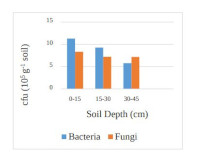
Microorganisms in the soil play a crucial role in plant growth, soil sustainability, the balance of the soil ecosystem, and the restoration of lost nutrients. This study was conducted to identify microbial populations at varying depths in the bamboo grove behind the University Health Centre of the Federal University of Agriculture, Abeokuta, Nigeria. Soil samples were collected at depths of 0–15 cm, 15-30 cm, and 30–45 cm for microbial analysis. The dilution spread plate method of identification of microbial population was used. The results showed that 7 bacterial species and 5 fungal strains were isolated from all the soil samples used. The probable isolated bacterial species were E coli, Bacillus subtilis, Clostridium septicum, Bacillus, Proteus, Enterobacter, Klebsiella aerogenes, and the isolated fungi species were Aspergillus funmigatus, Alternaria alternate, Aspergillus niger, Penicillium spp, and A niger. The microbial colony-forming units decreased progressively with increasing soil depth, indicating microbial activity is highest within the top 0-30 cm. This suggests that the upper soil layer should remain undisturbed as it contains vital microorganisms essential for nutrient recycling and plant productivity. The morphological characteristics of the isolated bacteria and fungi indicate that the Bacillus spp and the Aspergillus spp are the dominant bacteria in the soil, highlighting their importance in organic matter decomposition and soil fertility enhancement. The study underscores the ecological significance of bamboo groves as a biodiversity hotspot that supports diverse microbial communities crucial for sustainable soil health and management.
Downloads
Article Details
Section

This work is licensed under a Creative Commons Attribution-NonCommercial-ShareAlike 4.0 International License.
How to Cite
References
Banik, R. L. (2015). Bamboo silviculture. In W. Liese & M. Köhl (Eds.), Bamboo: The plant and its uses (pp. 113–174). Cham: Springer International Publishing. https://doi.org/10.1007/978-3-319-14133-6_5
Bhattarai, A., Bhattarai, B., & Pandey, S. (2015). Variation of soil microbial population in different soil horizons. Journal of Microbiology and Experimentation, 2(1), 44. https://doi.org/10.15406/jmen.2015.02.00044
Chen, L., Liu, C., Zhang, L., Zhao, Y., Xu, Z., & Li, Q. (2019). Soil microbial community structure and function in bamboo forests across a soil fertility gradient. Forest Ecology and Management, 447, 1–10. https://doi.org/10.1016/j.foreco.2019.05.056
Haines, J. (1995). Aspergillus in compost: Straw man or fatal flaw. BioCycle, 6(1), 32–35.
Joshi, R., Kumar, P., & Sharma, S. (2020). Microbial diversity and soil nutrient dynamics in bamboo-based agroforestry systems. Environmental Monitoring and Assessment, 192(4), 219. https://doi.org/10.1007/s10661-020-8180-9
Kleinhenz, V., & Midmore, D. J. (2001). Aspects of bamboo agronomy. Advances in Agronomy, 74, 99–145. https://doi.org/10.1016/S0065-2113(01)74033-4
Li, Z. H., & Kobayashi, M. (2004). The plantation future of bamboo in China. Journal of Forestry Research, 15(3), 233–242. https://doi.org/10.1007/BF02911032
Nath, A. J., Lal, R., & Das, A. K. (2015). Managing bamboo forests for carbon farming and carbon trading. Global Ecology and Conservation, 3, 654–663. https://doi.org/10.1016/j.gecco.2015.03.002
Sharma, G., Sahoo, U. K., & Barik, S. K. (2021). Influence of bamboo plantation on soil properties and microbial biomass in degraded lands. Land Degradation & Development, 32(8), 2671–2683. https://doi.org/10.1002/ldr.3892
Tabbene, O., Ben Slimene, I., Bouabdallah, F., Mangoni, M. L., Urdaci, M. C., & Limam, F. (2009). Production of anti-methicillin-resistant Staphylococcus activity from Bacillus subtilis sp. strain B38, newly isolated from soil. Applied Biochemistry and Biotechnology, 157(2), 407–419. https://doi.org/10.1007/s12010-008-8277-5
Tripathi, S. K., Kushwaha, C. P., & Singh, K. P. (2016). Dynamics of microbial biomass and nutrient cycling under bamboo-based land-use systems. Soil Biology and Biochemistry, 93, 50–59. https://doi.org/10.1016/j.soilbio.2015.10.005
Zhou, B. Z., Fu, M. Y., Xie, J. Z., Yang, X. S., & Li, Z. C. (2005). Ecological functions of bamboo forest: Research and application. Journal of Forestry Research, 16(2), 143–147. https://doi.org/10.1007/BF02857909
Zhou, G. M., Meng, C. F., Jiang, P. K., & Xu, Q. F. (2011). Review of carbon fixation in bamboo forests in China. The Botanical Review, 77(4), 262–270. https://doi.org/10.1007/s12229-011-9082-z