

SPATIAL VARIABILITY OF SOIL pH AND CEC USING PREDICTIVE MODELS IN THE MOUNTAINOUS REGION OF OBANLIKU, CROSS RIVER STATE, NIGERIA
Article Sidebar
Abstract Views | Downloads: 1328 / 167
Main Article Content
Abstract
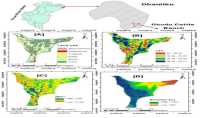
This study predicted the distribution pH and CEC in Obudu Cattle Ranch, Obanliku Local Government Area of Cross River State. Sixty (60) composite soil samples were collected (0-30 cm) between 200 to 500 m apart for the study. Normalized difference moisture index (NDMI), land surface temperature (LST), normalized difference vegetation index (NDVI), soil adjusted vegetation index (SAVI), clay, soil organic carbon and pH were used as covariates. Multiple linear regression (MLR), random forest (RF), ordinary kriging (OK), cubist regression (CR) and regression kriging (RK) were used to predict soil pH and CEC and were evaluated using bias, coefficient of determination (R2 ), and root mean square error (RMSE), mean square error (MSE) and Lin’s concordance correlation coefficient (CCC). The soils had pH varying from strongly acidic (pH=5.2) to slightly acid (pH=6.6) with high OC (>2 %). CEC of the soil was high (25 to 40 cmol/kg). CEC model estimated using OK had strong degree of spatial dependence while pH model had a moderate degree of spatial dependence. CEC predicted models showed almost similar spatial pattern with high CEC found in western part of the study. The highest predicted pH values dominated western part while the least predominated eastern parts of the study area in all the models. Cubist model better predicted CEC (CCC=0.605; MSE=28.79; RMSE=5.366) followed by MLR (R2=0.552) than other models whereas pH was better modeled by OK (CCC=0.636; MSE=0.103; RMSE=0.322) followed by RF (RF=0.664). Cubist and OK should be used for assessment of spatial variation of CEC and pH in mountainous areas.
Downloads
Article Details
Issue
Section

This work is licensed under a Creative Commons Attribution-NonCommercial-ShareAlike 4.0 International License.
How to Cite
References
Afu, S. M., Olim, D. M., Afangide, A. I., Ediene, V. F., Akpama, A. I. & Bisong, S. B. (2024). Assessment of soil quality for sustainable land
management using machine learning and digital soil mapping techniques in Obudu Cattle Ranch, Nigeria. Global Journal of Agricultural
Sciences, 23(1):71-83
Ballabio, C. (2009). Spatial prediction of soil properties in temperate mountain regions using support vector regression. Geoderma. 151(3-
4):338-350
Chalchissa, F. B. & Kuris, B. K. (2024). Modeling the impacts of extreme climate scenarios on soil acidity (pH and exchangeable aluminum) in
Abbay River Basin, Ethiopia. Heliyon, 10(12). e33448.
Cuni-Sanchez, A., Pfeifer, M., Marchant, R. & Burgess, N. D. (2016). Ethnic and locational differences in ecosystem service values: Insights from the communities in forest islands in the desert. Ecosystem Services, 19:42–50.
Cuni-Sanchez, A., Aneseyee, A. B., Baderha, G. K. R., Batumike, R., Bitariho, R., Imani, G., Jha, N., Kaganzi, K. R., Kaplin, B. A., Klein, J. A., Leite, A., Marchant, R. A., Martin,E.H., Mcharazo, F., Mwangi, B., Ngute, A. S. K., Nkengurutse,J., Nkurunziza, A., Olaka, L., Soromessa, T., Tchoffo, R. O. K.,
Thorn, J. P. R., Twinomuhangi, I., Sullivan, M. J. P., & Zafra-Calvo, N. (2025). Perceived climate change impacts and adaptation responses in
ten African mountain regions. Nature Climate Change.
Essington, M.E. (2006). Soil and water chemistry: An integrative approach. CRC Press, New York.
FAO (2015a). Understanding mountain soils. A contribution from mountain areas to the International Year of Soils
FAO (2015b). Mapping the Vulnerability of Mountain Peoples to Food Insecurity. Authors: Romeo R, Vita A, Testolin R, Hofer T. Rome, Italy: FAO
FAO & ITPS (2015). Status of the World’s Soil Resources (SWSR)-Main Report. Food and Agriculture Organization of the United Nations and Intergovernmental Technical Panel on Soils. Rome, Italy.
Fick, S. E. & Hijmans, R. J. (2017) WorldClim 2: new 1km spatial resolution climate surfaces for global land areas. International Journal of
Climatology 37 (12): 4302-4315.
Foth, H.D. (2006). Fundamentals of soil science. 8Ed. John Wiley and Sons. New York.
Fox, E. W., Ver Hoef, J. M. & Olsen, A. R. (2020). Comparing spatial regression to random forests for large environmental data sets. PLoSONE
15(3): e0229509.
Freeman, E. A, Moisen, G. G, Coulston, J. W. & Wilson, B. T. (2015). Random forests and stochastic gradient boosting for predicting tree canopy
cover: comparing tuning processes and model performance. Canadian Journal of Forest Research, 45,1–17.
Gee, G.W. & Or, D. (2002). Particle Size Analysis. In: Methods of Soil Analysis, Part 4, Physical Methods, Dane, J.H. and G.C. Topp (Eds.).
ASA and SSSA, Madison, WI., 255- 293.
Grundwald, S. (2009). Multi-criteria characterization of recent digital soil mapping and modeling approaches. Geoderma. 152 (3-4):195-207
Hastie, T., Tibshirani, R. & Friedman, J. (2009). The elements of statistical learning: data mining, inference, and prediction. 2nd ed. Springer Series in Statistics. Springer, New York.
Javed, A., Ali, E., Afzal, K.B., Osman, A. & Riaz, S. (2022). Soil Fertility: Factors Affecting Soil Fertility, and Biodiversity Responsible for Soil Fertility. International Journal of Plant, Animal and Environmental Sciences, 12, 021-033.
John, K., Solomon, O. L., Ayito, O. E., Kebonye, M. N., Ogeh, J. S. & Vít, P. (2019). Predictive Mapping of Soil Properties for Precision Agriculture
Using Geographic Information System (GIS) Based Geostatistics Models. Modern Applied Science, 13 (10), 60-77.
Jones, C. & Jacobsen, J. (2005). Plant nutrition and soil fertility. Environ. Sci., 2. 1-12
Kashi, H., Emamgholizadeh S. & Ghorbani H. (2014). Estimation of soil infiltration and cation exchange capacity based on multiple
regression, ANN (RBF, MLP), and ANFIS models. Communications in Soil Science and Plant Analysis, 45(9), 1195–1213.
Kaya, F., Mishra, G., Francaviglia, R. & Keshavarzi, A. (2023). Combining Digital Covariates and Machine Learning Models to Predict the Spatial Variation of Soil Cation Exchange Capacity. Land, 12, 819.
Kerry, R. & Oliver, M. A. (2004). Average variograms to guide soil sampling for land management. International Journal of Applied Earth
Observation, 5, 307-325
Kuhn, N. I. (2013). Linking soil and sediment properties for research on biogeochemical cycles. Geophysical Research Abstract, 15
Landon, J. R. (1991). Booker Tropical Soil Manual. A handbook for soil survey and agricultural land evaluation in the tropics and sub tropics. John Wiley and Sons, New York. 474.
Li, C., Wang, X. & Qin, M. (2021) Spatial variability of soil nutrients in seasonal rivers: A case study from the Guo River Basin, China. PLoS ONE,
16, e0248655.
Liu, J., Zheng, X., Luo, Q., Xiao, Q., Liu, S. & Oba, B. T. (2025). Soil pH decline promotes organic carbon accumulation by regulating the
microbial carbon sequestration pathway. Climate Smart Agriculture. 2(3), 100068
Mishra, G., Sulieman, M.M., Kaya, F., Francaviglia, R., Keshavarzi, A., Bakhshandeh, E., Loum, M., Jangir, A., Ahmed, I. & Elmobarak, A.
(2022). Machine Learning for Cation Exchange Capacity Prediction in Different Land Uses. Catena, 216, 106404.
Mohammad, Z. M., Taghizadeh-Mehrjardi, R.& Akbarzadeh, A. (2010). Evaluating geostatistical techniques for mapping spatial distribution of
soil pH, salinity and plant cover affect by environmental factors in Southern Iran. Notulae Scientia Biologicae, 2. 92-103
Nelson, D. W. & Sommers, L. E. (1996). Total carbon, organic carbon and organic matter. In D.L. Sparks (Eds.). Methods of soil analysis. Part 3. Chemical methods. SSSA Book Ser. 5. SSSA, Madison, WI. 961-1010.
Nsengiyumva, P. (2019). African mountains in a Changing Climate: Trends, Impacts, and Adaptation Solutions. Mountain Research and
Development, 39(2):1-9.
Olorunfemi, I., Fasinmirin, J. & Ojo, A. (2016). Modeling cation exchange capacity and soil water holding capacity from basic soil properties.
Eurasian Journal of Soil Science, 5(4), 266– 274.
Quinlan, J. R. (1992). Learning with continuous classes. In Proceedings of the 5th Australian Joint Conference on Artificial Intelligence, Tasmania, Australia, 16–18 Nov. 1992; pp. 343–348.
Reddy, N. N. & Das, B. S. (2023). Digital soil mapping of key secondary soil properties using pedotransfer functions and India Legacy Soil
Data. Geoderma. 429.
Seyedmohammadi, J., Esmaeelnejad, L. & Ramezanpour, H. (2016). Determination of a suitable model for prediction of soil cation exchange capacity. Modeling Earth Systems and Environment, 2(3), 1– 12.
Tan, H. K. (2011). Principle of Soil Chemistry. 3rd Ed. Marcel Dekker Inc. New York.
Udo, E. J., Ibia, T.O., Ogunwale, J.O., Ano, A.O. & Esu, I. (2009). Manual of Soil, Plant and Water Analysis. Sibon Books Ltd. Lagos.
Wang, Y., Shao, M., Liu, Z. & Horton, R. (2013). Regional-scale variation and distribution patterns of soil saturated hydraulic conductivities in surface and subsurface layers in the loessial soils of China. Journal of Hydrology, 487, 13–23.
WMC (World Mountain Conference) (2011). 20 years of sustainable mountain development in Africa. Lucerne, Switzerland. 11 and 12 October 2011